YouTube pay per 1,000 views: the key numbers
Updated 10 November 2026. Every figure links to the publisher that produced it. Where we did the arithmetic ourselves, the table says so.
| What | Figure | Source |
|---|---|---|
| Creator share of ad revenue on long-form videos | 55% | YouTube Help |
| Creator share of allocated Shorts revenue | 45% | YouTube Help |
| Median long-form RPM, 300 channels | $2.30 per 1,000 views | AIR Media-Tech, May 2025 to May 2026 |
| Views that actually showed an ad (median) | 53% | AIR Media-Tech, same study |
| Highest niche median RPM | Education & Science, $10.22 | AIR Media-Tech |
| Lowest niche median RPM | Kids & Teens, $0.33 | AIR Media-Tech |
| Shorts RPM range by niche | $0.02 to $1.48 per 1,000 views | AIR Media-Tech, 274 channels |
| Views needed to earn $100 at the median | About 43,500 | AIR Media-Tech |
| Long-form RPM reported by 8 creators | $1.61 to $29.30 | Business Insider, 2023 |
| 1 million long-form views at the median RPM | About $2,300 | Calculated by Metricvia from AIR's median |
RPM and CPM: the number you get paid on
Most of the confusion about YouTube pay comes from two similar looking terms in YouTube Studio. YouTube defines CPM as the cost per 1,000 ad impressions before its revenue share. It is what advertisers pay. RPM is your total revenue per 1,000 views after the revenue share, and it counts money from ads, YouTube Premium, channel memberships, Super Chat and Super Stickers.
RPM is the number to use when you ask how much YouTube pays. It is almost always well below CPM, because it is measured per view, and many views never show an ad. A viewer may use an ad blocker, watch a video that is not ad suitable, or leave before the first ad. In AIR Media-Tech's data, the median channel had an ad on 53% of its views, and each of those views carried about 1.55 ads.
A worked example makes the gap clear. The $10 CPM below is made up to keep the maths simple; the other inputs are the AIR medians.
- 1,000 views, of which 53% show an ad: 530 monetized views.
- 530 monetized views with 1.55 ads each: about 820 ad impressions.
- 820 impressions at a $10 CPM: $8.20 paid by advertisers.
- Creator share of 55%: about $4.51. That is the RPM, less than half the CPM.
YouTube RPM by niche
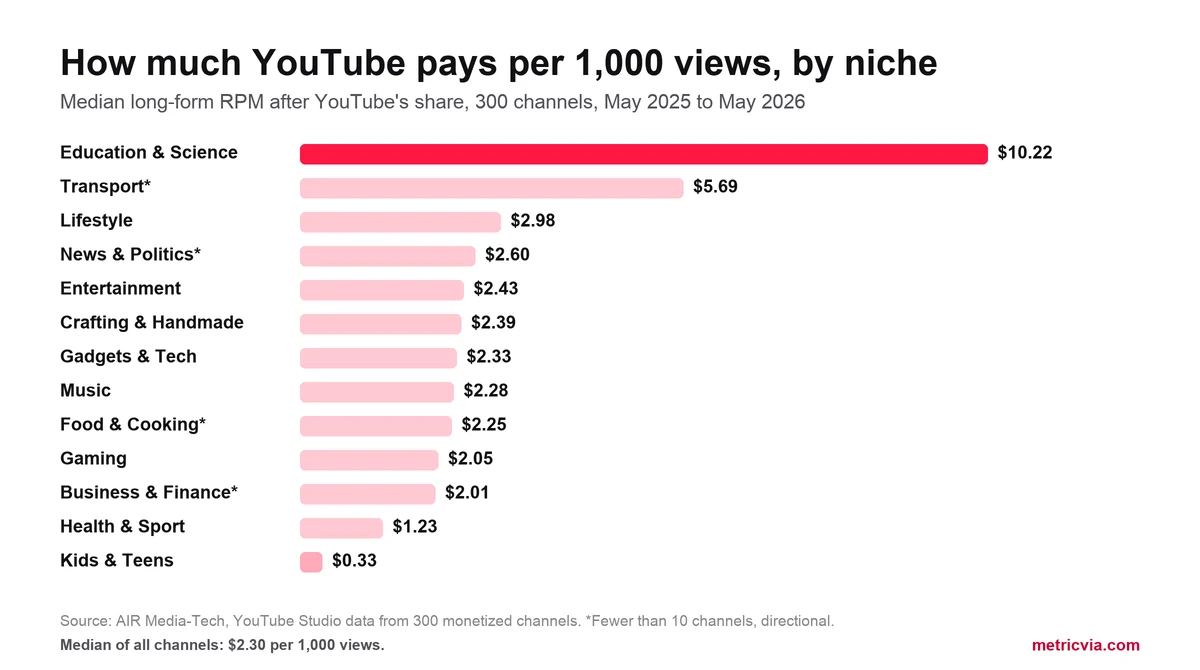
Topic changes pay more than anything else you control. In AIR Media-Tech's 300 channels, the median education channel earned about 31 times more per view than the median kids channel. Advertisers pay more to reach people who are learning, comparing products or planning a purchase, and much less on content made for kids, where YouTube does not show personalised ads.
The spread inside a niche is wide too. The middle half of education channels earned anywhere from $2.31 to $19.50 per 1,000 views. So use the median as a starting point and your own Studio data as soon as you have it.
| Niche | Median RPM | Middle half of channels |
|---|---|---|
| Education & Science | $10.22 | $2.31 to $19.50 |
| Transport* | $5.69 | $3.17 to $9.81 |
| Lifestyle | $2.98 | $1.77 to $5.24 |
| News & Politics* | $2.60 | $1.79 to $3.62 |
| Entertainment | $2.43 | $0.88 to $5.02 |
| Crafting & Handmade | $2.39 | $1.00 to $3.90 |
| Gadgets & Tech | $2.33 | $0.70 to $3.71 |
| Music | $2.28 | $1.35 to $4.16 |
| Food & Cooking* | $2.25 | $1.50 to $3.11 |
| Gaming | $2.05 | $0.70 to $3.62 |
| Business & Finance* | $2.01 | $0.73 to $5.17 |
| Health & Sport | $1.23 | $0.72 to $1.53 |
| Kids & Teens | $0.33 | $0.16 to $0.88 |
Why two channels with the same views earn different amounts
Niche is the biggest factor, but it is not the only one. These are the others that show up clearly in the data.
- Audience country. Advertisers pay far more for some viewers than others. AIR Media-Tech's country data, first published in June 2025, puts the advertiser CPM at $14.67 in the United States and $0.74 in India. A channel with a mostly U.S. audience will usually earn more per view than the same channel watched mainly in South Asia.
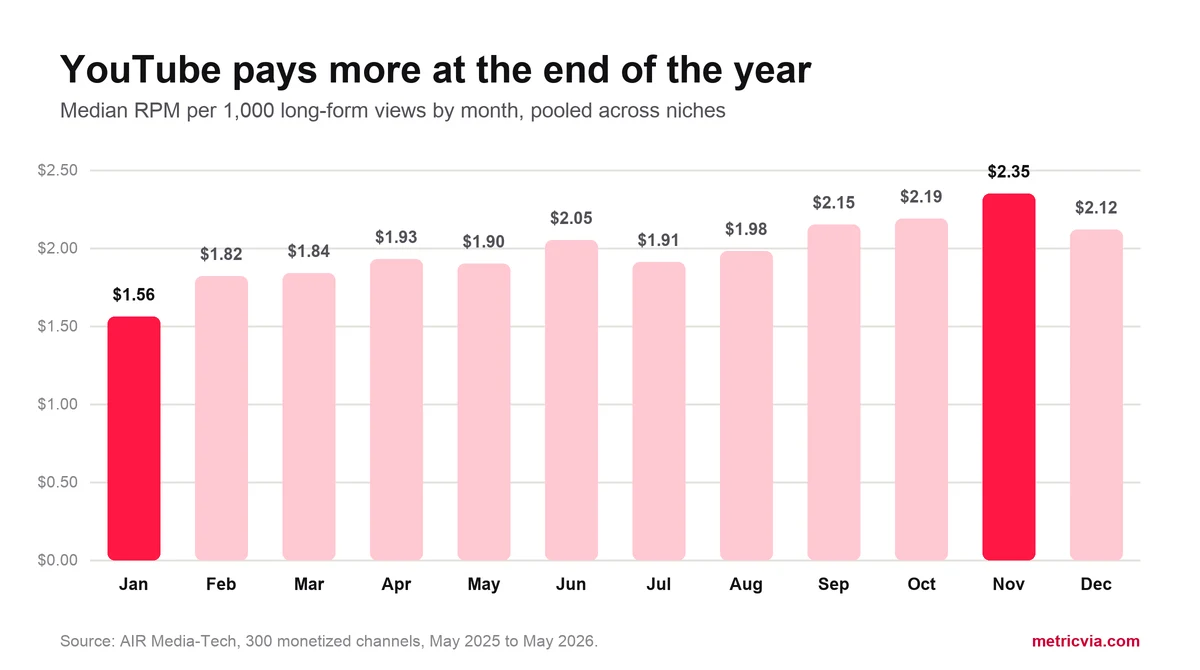
- Time of year. Ad budgets rise before the holidays and fall in January. Pooled across niches, AIR's median RPM went from $1.56 in January to $2.35 in November. A video that takes off in late autumn earns more than the same video in January.
- Share of views that show an ad. This ranged from 77% for education channels to 32% for kids channels in AIR's data. Videos that are not suitable for most advertisers earn little even with millions of views.
- Video length. YouTube lets videos of 8 minutes or longer carry <a href="https://support.google.com/youtube/answer/6175006" rel="nofollow noopener" target="_blank">mid-roll ads</a>, so one view can show more than one ad. That is part of why longer formats tend to have a higher RPM.
- Channel size matters less than people think. AIR found a pooled median RPM of $2.14 for channels with 10,000 to 100,000 subscribers and $2.04 for channels with 100,000 to 10 million. Bigger channels earn more in total because they get more views, not because each view pays more.
How much YouTube Shorts pay
Shorts pay a fraction of what long videos pay. In AIR Media-Tech's study of 274 channels, Shorts RPM ranged from $0.02 to $1.48 per 1,000 views depending on niche, and in almost every niche it came to 3% to 14% of the same channel's long-form RPM. Most channels needed 11,000 to 34,000 Shorts views to earn what 1,000 long-form views paid. For most channels in the study, Shorts brought in less than 2% of total revenue.
Creator reports point the same way. Business Insider spoke to seven Shorts creators in 2023 who earned $0.04 to $0.06 per 1,000 views. Riley Lemon, a creator featured in the same report, made $383.13 in a month from 7 million Shorts views.
Shorts are still useful. They bring in viewers who may go on to watch your long videos, and that is where most of the money is made. From 1 February 2027, YouTube says creators will need 10 million qualified Shorts views in 90 days to share in Shorts revenue at all.
What creators say they earn
Creator disclosures are useful as a check on the averages, but each one is a single channel at a single moment. Business Insider asked eight long-form creators for their RPM and got answers from $1.61 to $29.30 per 1,000 views. The highest belonged to personal finance creator Josh Mayo, whose RPM rose from about $6 in October 2021 to $29.30 in October 2022. Personal finance is a topic advertisers pay a lot to appear next to.
Those reports are from 2022 and 2023, so treat them as examples of the range rather than current rates. The point they make still holds: two channels with the same view count can be paid very different amounts.
How to estimate what your views will pay
The formula is short: earnings = views × RPM ÷ 1,000. If your channel is already monetized, take your own RPM from the Revenue tab in YouTube Studio, ideally an average over several months so one good or bad month does not distort it. If you are not monetized yet, start with the median for your niche from the table above.
The table below runs 100,000 long-form views through a few of those medians. For a quick estimate with your own numbers, use our free YouTube money calculator. For a look at the very top of the scale, see what the biggest YouTubers earn.
| RPM used | Per 1,000 views | For 100,000 views |
|---|---|---|
| Kids & Teens median | $0.33 | $33 |
| Health & Sport median | $1.23 | $123 |
| All-niche median | $2.30 | $230 |
| Lifestyle median | $2.98 | $298 |
| Education & Science median | $10.22 | $1,022 |
How to cite this page
You are welcome to use the tables and the two charts. Please credit the original source of each figure and link to this page: Metricvia, "How Much Does YouTube Pay per 1,000 Views? Real RPM Data for 2026", updated 10 November 2026, https://metricvia.com/blog/how-much-does-youtube-pay/.
We update this page when YouTube changes its revenue share rules or when new RPM data is published.
Frequently asked questions
How much does YouTube pay for 1,000 views?
The median monetized channel earns about $2.30 per 1,000 long-form views after YouTube's share, according to AIR Media-Tech's data from 300 channels. Depending on niche, medians ran from $0.33 to $10.22.
How much does YouTube pay for 1 million views?
At the $2.30 median RPM, 1 million long-form views pay about $2,300. At the niche medians it ranges from about $330 for kids content to about $10,220 for education and science.
What is the difference between RPM and CPM on YouTube?
CPM is what advertisers pay per 1,000 ad impressions, before YouTube's share. RPM is what you earn per 1,000 views after YouTube's share, counting all your revenue sources. RPM is the number that shows what you actually get paid.
How much of the ad money does YouTube keep?
On long-form videos, YouTube pays creators 55% of net ad revenue and keeps 45%. On Shorts, creators keep 45% of the revenue allocated to them from the Creator Pool.
Do YouTube Shorts pay less than long videos?
Yes, by a wide margin. AIR Media-Tech found Shorts paid 3% to 14% of long-form RPM in almost every niche, so most channels needed 11,000 to 34,000 Shorts views to earn what 1,000 long-form views paid.
Official references
Platform rules and product names can change. Use these official YouTube and Google pages to verify the current position before making a campaign or monetisation decision.