Ten minutes before public: run the boring checks
Open the video on a phone and watch the first minute with ordinary mobile data. Check the sound, captions, crop and end screen. Then read the title and look at the thumbnail at the size they will appear on Home. This catches more useful problems than staring at the full-size artwork on a desktop monitor.
Confirm that the description contains the links you actually mention, that chapters open at the right moments, and that the audience setting is correct. If the video contains a paid relationship, make the disclosure before launch. None of this is exciting, which is exactly why it is easy to skip. A broken link or wrong visibility setting can waste the cleanest part of the release window.
- Watch the opening on a phone with sound on and off
- Test every important link and chapter timestamp
- Check captions, audience setting and disclosures
- Make sure the thumbnail still reads at a small size
The first hour: be present, but do not start rebuilding
Once the video is public, check that it appears correctly on the channel page and share it with the people who already expect to hear from you. That might be an email list, a community post or one relevant social account. Send a short reason to watch rather than dropping a naked link everywhere. A useful sentence beats ten generic announcements.
Stay available for early comments. Reply where you can add something, clarify a point or welcome a familiar viewer. Do not paste the same response under every comment, and do not ask friends to leave empty reactions. The aim is a real conversation around the subject, not a burst of activity that means nothing.
Hours two to six: check the promise against the opening
This is a good time to watch the title, thumbnail and first 30 seconds as one unit. Do they make the same promise? If the packaging suggests a quick answer but the video opens with a long backstory, viewers will feel the gap immediately. Write that observation down even if you decide not to edit anything yet.
Look for obvious technical failures, not tiny performance fluctuations. A thumbnail that is unreadable on mobile or a title with a factual mistake deserves a correction. A click-through rate that moved after a small number of impressions does not. Early percentages can swing sharply because each new viewer represents a large part of the sample.
The first evening: read the traffic source before the total
The public view counter cannot tell you why the video is moving. Open YouTube Studio and see where viewers are arriving from. Subscribers, Browse, Search, Suggested and external links each create a different early pattern. A search-led tutorial may build slowly and steadily. A community-led release may arrive quickly, then level off. Neither shape is automatically better.
Also compare new and returning viewers when the report is available. Returning viewers tell you whether the release reached the audience you have already built. New viewers show whether the topic or distribution found people beyond that circle. The balance should match the job of the video. A series episode can lean toward returning viewers; a broad beginner guide should usually reach further.
The next morning: find one retention clue
Do not try to diagnose the entire video from an immature graph. Look for one clear clue. Did viewers leave during a long setup? Was there a sudden dip when the video switched topic? Did a chapter hold attention better than the rest? One strong signal is enough to improve the next upload.
Treat retention as a conversation, not a score. A dip often means the viewer received what they came for, lost the thread or met a section that felt less relevant. The graph tells you where to look, but you still need to watch that moment and make a judgement. The lesson belongs in your next script, not in a frantic attempt to cut the live video into pieces.
When should you change the title or thumbnail?
Change packaging when impressions are arriving, viewers are not choosing the video, and you have a meaningfully clearer idea. Do not change it simply because the first few hours feel quiet. A new upload can take time to find its natural audience, especially when the channel is small or the topic depends on Search.
If you do make a change, change either the title or the thumbnail first and note the time. That gives you a chance to understand what helped. Replacing both repeatedly turns the launch into a blur. The new version should sharpen the same honest promise, not invent a bigger promise that the video cannot keep.
Where paid promotion can fit
Paid promotion is most useful after the video has passed the basic checks. Advertising can introduce the upload to a selected audience, but it cannot repair a confusing opening or force people to care. If the packaging is clear and the video holds attention reasonably well, a modest campaign can help test a country or audience that organic distribution has not reached yet.
Keep the first test narrow enough to learn from. Define the video, location, budget and campaign dates before starting. Then compare watch behaviour and follow-on viewing with your usual baseline. Metricvia uses managed Google Ads delivery for worldwide promotion and country-targeted campaigns; the viewer still chooses whether to watch, subscribe or return.
What not to do during a slow launch
Do not buy bot traffic, trade comments in engagement groups or push the link into unrelated communities. Those actions may move a visible number while making the audience data harder to trust. They also teach you nothing about whether the topic, packaging or video worked with the people it was made for.
Do not delete and reupload because the first evening was quiet unless there is a serious technical or legal problem. You lose the original URL, comments and any learning already gathered. Most videos are not decided in one evening. Give the release enough time to show its real shape.
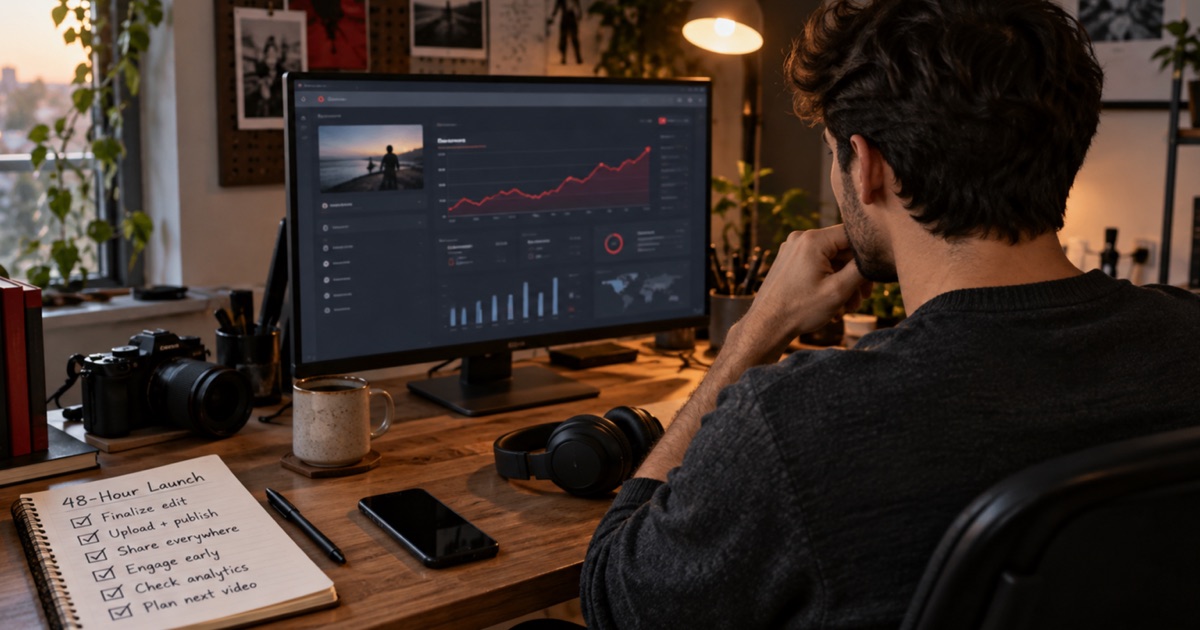
At 48 hours: write a six-line launch note
Finish the launch by writing down the title, thumbnail idea, main traffic source, strongest retention moment, clearest weak point and one decision for the next video. Keep it short. The note is valuable because memory quickly rewrites a launch into “it did well” or “it failed,” while the details that would improve your work disappear.
After that, move on to the next useful action. Reply to thoughtful comments, connect the video to a relevant playlist, or start the follow-up that viewers asked for. The best launch routine does not trap you in analytics. It turns the last upload into a better next upload. If the first-day numbers justify it, a small campaign for likes or subscribers on the same video keeps the signals YouTube reads moving in the same direction.
If the launch window passes quietly, our guide on why your videos are not getting views walks through the usual causes.
Before you hit publish, the free description generator and hashtag generator save a few minutes on the checklist.
Titles, descriptions and tags are set before publishing; our YouTube SEO guide covers what actually moves rankings.
Frequently asked questions
Should I share my YouTube video everywhere as soon as it is published?
Share it where the topic is genuinely relevant and add a reason for that audience to care. Broad, context-free link dumping can bring poor-fit viewers and gives you little useful feedback.
Is the first 24 hours still important on YouTube?
It is useful for early feedback, but it is not a universal deadline. Search-led and evergreen videos can find their audience over weeks or months, so avoid judging the whole life of a video from day one.
When should I change a YouTube thumbnail?
Consider a change when the video is receiving meaningful impressions but the packaging is not earning enough clicks, and you have a clearer honest concept to test. Record the time of the change so you can compare the result.
Can I promote a video with Google Ads on the first day?
Yes, provided the video has passed basic quality, policy and packaging checks. Start with a defined audience and modest budget, then judge the campaign as paid distribution rather than a guarantee of organic recommendations.
Official references
Platform rules and product names can change. Use these official YouTube and Google pages to verify the current position before making a campaign or monetisation decision.